recent research work
Press : Getting good results at a bargain basement price
Biophotonics International speaks about our research ! See the full article at :
http://www.photonics.com/Content/ReadArticle.aspx?ArticleID=35739
Latest paper published : review nanoapertures
In the November issue of Histochemistry and Cell Biology : open access to download here
Abstract: During the past years, nanophotonics has provided new approaches to study the biological processes below the optical diffraction limit. How single molecules diffuse, bind and assemble can be studied now at the nanometric level, not only in solutions but also in complex and crowded environments such as in live cells. In this context fluorescence fluctuations spectroscopy is a unique tool since it has proven to be easy to use in combination with nanostructures, which are able to confine light in nanometric volumes. We review here recent advances in fluorescence fluctuations’ analysis below the optical diffraction limit with a special focus on nanoapertures milled in metallic films. We discuss applications in the field of single-molecule detection, DNA sequencing and membrane organization, and underscore some potential perspectives of this new emerging technology.
Keywords: Biophotonics - Single molecules - Fluorescence fluctuations - Nanostructures - Plasma membrane

Latest paper : single molecule fluorescence close to microspheres
Published in September 15th issue of Optics Express :
http://oe.osa.org/abstract.cfm?uri=oe-16-19-15297
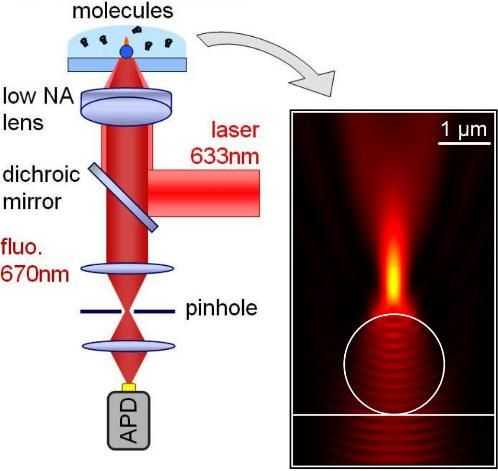
It’s the first experimental and theoretical report of a new effect : the 3-axis subwavelength confinement of light by a high refractive index microsphere. Freely available for download !
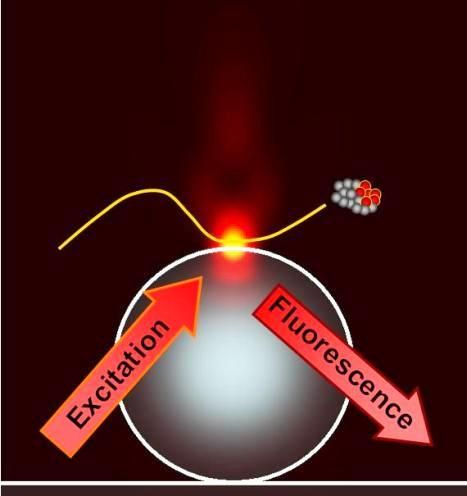
Abstract: Latex microspheres are used as a simple and low-cost means to achieve three axis electromagnetic confinement below the standard diffraction limit. We demonstrate their use to enhance the fluorescence fluctuation detection of single molecules. Compared to confocal microscopy with high numerical aperture, we monitor a detection volume reduction of one order of magnitude below the diffraction limit together with a 5-fold gain in the fluorescence rate per molecule. This offers new opportunities for a broad range of applications in biophotonics, plasmonics, optical data storage and ultramicroscopy.
Latest paper published : microspheres for fluorescence detection
Just published in September 1 issue of Analytical Chemistry :
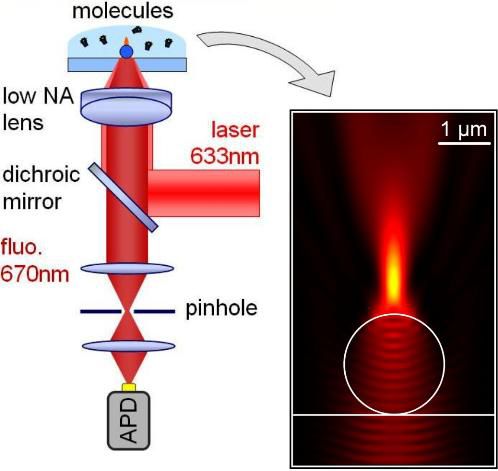
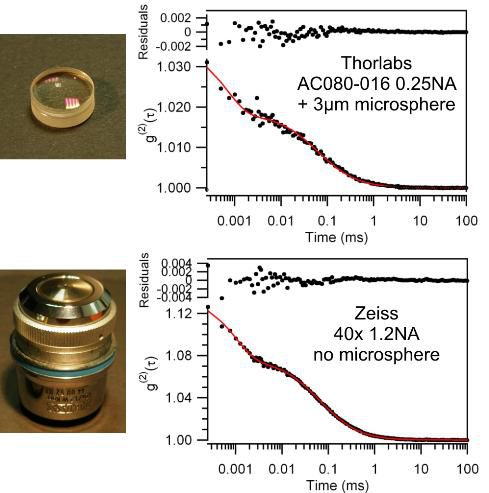
An inexpensive low numerical aperture lens is used instead of a costly conventional high NA microscope objective to detect single molecule fluorescence, thanks to a latex microsphere set at the lens focus. The graphs below show fluorescence intensity correlation functions obtained with a 0.25NA doublet and a 3 µm microsphere and reference correlation function with a standard water-immersion 1.2NA microscope objective and no microsphere.
We demonstrate viable FCS experiments at concentrations 1−1000 nM with different objectives costing less than $40. This offers a simple and low-cost alternative to the conventional complex microscope objectives.
Photonics Spectra highlights the observation of nanojets
See the paper by Lynn Savage in the July issue on the recent work of “Patrick Ferrand and colleagues at the Fresnel Institute” :
http://www.photonics.com/content/spectra/2008/July/microscopy/92560.aspx


/image%2F1383851%2F20250422%2Fob_a7cec0_logomosaic.png)
/image%2F1383851%2F20250422%2Fob_3502a9_logocnrs.jpg)
