End of year thinking: stay true to yourself
Good period to take some distance from our daily routine and think about ourselves. But who are we by the way? True individuals or mirrors of somebody else? Think of it, and til next time, live like a nanopirate!
Warning: the video below is giving the hard truth, and it may hit hard. Sensitive readers, fasten your seatbelts.
Jerome Wenger is a nominee for the Jean Jerphagnon prize 2016
The Jean Jerphagnon prize aims to promote a young researcher with an innovative project of high scientific and/or industrial interest. This year, Jerome went with a project on "label-free molecular biosensor using dual-color photon cross correlation spectroscopy" following the promising results of his ERC Proof-of-Concept grant PhoCCS. Out of a total of 18 candidates, Jerome is one of the 6 nominees. The winner's name should be disclosed by the end of February.
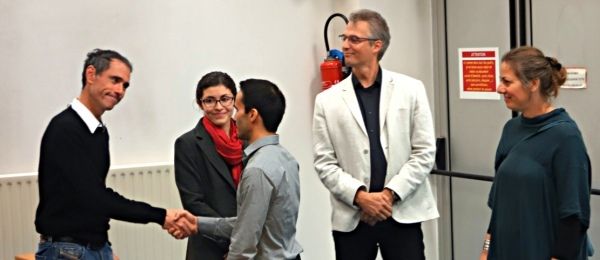
Juan is now Dr. de Torres
Congratulations Juan for the successful PhD defense on nanophotonic control of Förster resonance energy transfer!

ERC Consolidator Project Funded!
Thanks to the ERC for empowering the scientists to follow their dreams.
Thanks to the panel members for their confidence.
Thanks to my colleagues for their support.
Freedom is to be true to one’s dreams.
We are going to make this vision a scientific reality.


Plasmonic nanoantennas enable forbidden FRET

FRET is highly sensitive to the mutual orientation of donor and acceptor dipoles, and can be strongly prohibited for perpendicularly oriented dipoles. However, all previous studies combining FRET with nanophotonics largely overlooked this orientation effect. In a recent Nano Letters article "Plasmonic Nanoantennas Enable Forbidden Förster Dipole–Dipole Energy Transfer and Enhance the FRET Efficiency", we show for the first time how to exploit the orientation dependence in FRET using plasmonic nanoantennas.
Significance:
- Nanoantennas can allow FRET even for perpendicularly oriented donor and acceptor pairs. This provides a new strategy using nanophotonics to reveal FRET interactions that would otherwise be impossible to probe with diffraction-limited microscopy.
- While all previous work were dominated by the plasmonic losses which compete with FRET and decrease the FRET efficiency, our approach exploiting the dipolar orientation effect overcomes the losses. We report the first gain in FRET efficiency using nanophotonics, which even reaches up to 50%.
- Numerical simulations elucidate this new FRET enhancement and reveal the crucial role of the simultaneous presence of electric field components along all three directions of space inside the nanogap. This bridges the gap between FRET orientation effects and near-field optics.

/image%2F1383851%2F20250422%2Fob_a7cec0_logomosaic.png)
/image%2F1383851%2F20250422%2Fob_3502a9_logocnrs.jpg)
