France / CNRS ranking
Back to the source…
Taken from ISI Web of Knowledge, here are the latest ranking for France and CNRS in physics.
If we just compare the total number of papers published, the froggies are not performing too bad, contrarily to what our government seems to say…


Latest paper published : microspheres for fluorescence detection
Just published in September 1 issue of Analytical Chemistry :
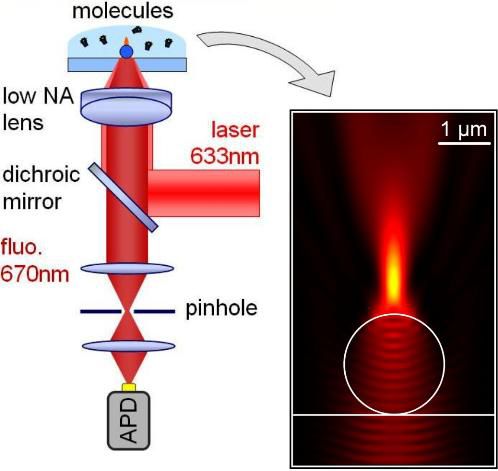
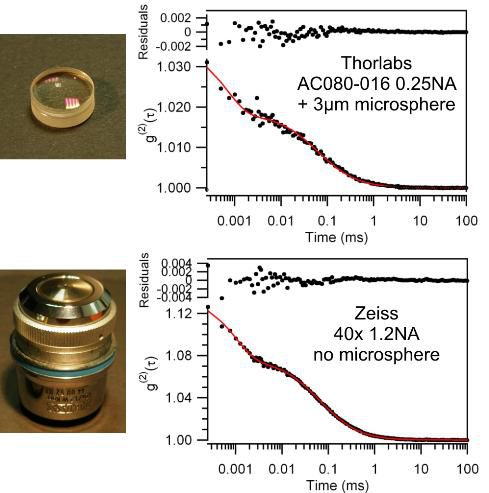
An inexpensive low numerical aperture lens is used instead of a costly conventional high NA microscope objective to detect single molecule fluorescence, thanks to a latex microsphere set at the lens focus. The graphs below show fluorescence intensity correlation functions obtained with a 0.25NA doublet and a 3 µm microsphere and reference correlation function with a standard water-immersion 1.2NA microscope objective and no microsphere.
We demonstrate viable FCS experiments at concentrations 1−1000 nM with different objectives costing less than $40. This offers a simple and low-cost alternative to the conventional complex microscope objectives.
Gordon Research Conference : Plasmonics
Back from the Plasmonics GRC in Tilton NH last July. As a synthesis, here is my selection of the top 10 hot stuff / challenges in the field for the next years, from the list that was written at the end of the meeting. The list was voluntary limited to ten items :
- Reproducible SERS and hot spot enhancement quantification
- Plasmonic structures inside bio cells
- Negative index devices
- Circuits models : new systems ?
- Plasmon laser / SPASER
- Plasmonics in energy sciences
- Role of disorder in plasmonics
- Non linear effects in plasmonics
- Graphene plasmons
- Plasmons in quantum information

Photonics Spectra highlights the observation of nanojets
See the paper by Lynn Savage in the July issue on the recent work of “Patrick Ferrand and colleagues at the Fresnel Institute” :
http://www.photonics.com/content/spectra/2008/July/microscopy/92560.aspx

OMNT article selection
This trimester’s selection is pretty short (sorry, I’m in a rush to finish several research projects). I pointed out a contribution of Jordan Gerton’s team in Optics Express :
http://www.opticsinfobase.org/abstract.cfm?URI=oe-16-9-6183
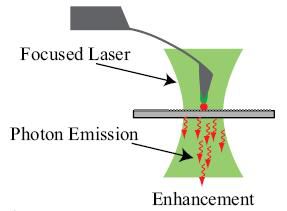
The papers points out a nice theoretical and experimental study on the limits of single-molecule fluorescence detection within a dense ensemble, using tip-enhanced near-field microscopy. Specifically, the minimum magnitude of tip-induced signal enhancement is discussed and compared to the capabilities of commercially available silicon tips. Last, the authors show that modulation of fluorescence signals induced by an oscillating tip followed by demodulation with a lock-in amplifier increases image contrast by nearly two orders of magnitude.

/image%2F1383851%2F20250422%2Fob_a7cec0_logomosaic.png)
/image%2F1383851%2F20250422%2Fob_3502a9_logocnrs.jpg)
