ResearcherID world resource
By clicking on the “published papers” link on the left, you’ll be redirected to the ResearcherID webpage, which contains an additional link to the ResearcherID new features “Labs”. Alternatively, this can be accessed directly by http://labs.researcherid.com/mashlets/rid/?rid=A-5657-2008
The most intriguing feature is the citing articles network, which enables you to visualize who’s citing your work. Sorting can be done by person, institutions, countries, years…
At the end, you’re on procrastinating for a few tens of minutes more, and can proudly (?) display a “citing network worldmap” as mine:

PS: my geekiness is getting worse each day…
Next international conferences
The following meetings are scheduled :
- France/Taiwan Frontier of Science Symposium, Taiwan, June 26-27
http://www-direction.inria.fr/international/ASIE_OCEANIE/FoS_France_Taiwan/

- Gordon Research Conference on Plasmonics, Tilton NH, July 26-31
http://www.grc.org/programs.aspx?year=2008&program=plasmonics

NanoLum workshop presentations
Full text presentations of the NanoLum workshop (luminescence of nano-objects) are freely available on the net : http://nanolum.univ-lyon1.fr/spip.php?article95 . For an introduction to topics related to nanophotonics, it’s nice to have a look at this website :
- near-field optics
- single molecule fluorescence
- advanced optical microscopy
- plasmonics
- nanoparticle detection

Mosaic Fellows
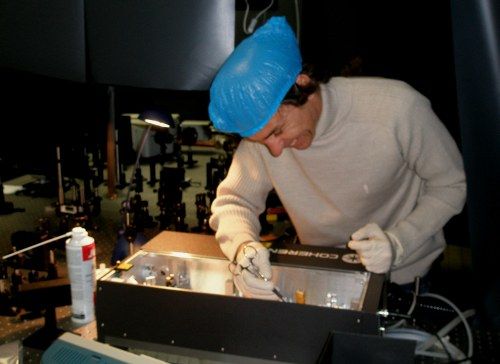
Some pics of Mosaic colleagues in action !
Dr. Hervé Rigneault
Dr. Pierre-François Lenne

Dr. Patrick Ferrand

Latest paper published : emission and excitation enhancements in single gold nanoapertures
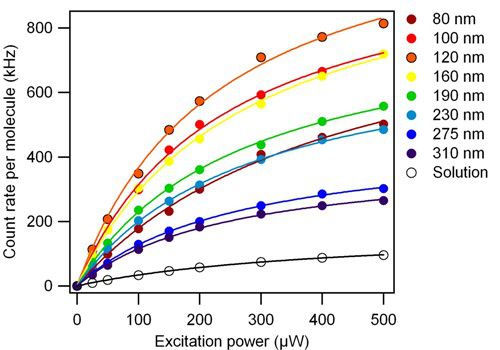
Released in the march 03rd issue of Optics Express : we detail the role of single nanometric apertures milled in a gold film to enhance the fluorescence emission of Alexa Fluor 647 molecules. By “detailing”, we mean we characterise the effects of the nanoaperture both on the excitation and emission phenomena that form the fluorescence process.
The major novelty in this study is the introduction of a fluorescence characterization procedure combining fluorescence correlation spectroscopy and fluorescence lifetime measurements.
For the first time, we characterize a broad range of nanoaperture diameters from 80 to 310 nm. This allows us to highlight the link between the fluorescence enhancement and the local photonic density of states.
These results are of great interest to increase the effectiveness of fluorescence-based single molecule detection and to understand the interaction between a quantum emitter and a nanometric metal structure.
Freely available for download : http://www.opticsexpress.org/abstract.cfm?id=154338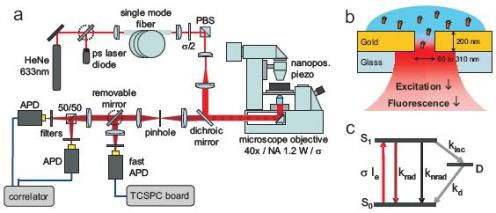

/image%2F1383851%2F20250422%2Fob_a7cec0_logomosaic.png)
/image%2F1383851%2F20250422%2Fob_3502a9_logocnrs.jpg)
