Review Surface-Enhanced Fluorescence
Emmanuel Fort and Samuel Grésillon recently published a very nice and complete review on surface-enhanced fluorescence. Highly recommended !
Fluorescence is widely used in optical devices, microscopy imaging, biology, medical research and diagnosis. Improving fluorescence sensitivity, all the way to the limit of single-molecular detection needed in many applications, remains a great challenge. The technique of surface enhanced fluorescence (SEF) is based upon the design of surfaces in the vicinity of the emitter. SEF yields an overall improvement in the fluorescence detection efficiency through modification and control of the local electromagnetic environment of the emitter. Near-field coupling between the emitter and surface modes plays a crucial role in SEF. In particular, plasmonic surfaces with localized and propagating surface plasmons are efficient SEF substrates. Recent progress in tailoring surfaces at the nanometre scale extends greatly the realm of SEF applications. This review focuses on the recent advances in the different mechanisms involved in SEF, in each case highlighting the most relevant applications.
Latest publication : plasmon-assisted enhancement in a single nanoaperture
Published recently in Optics Express, it’s freely available at :
http://www.opticsinfobase.org/abstract.cfm?URI=oe-16-3-2276
A single nanometric aperture surrounded by a circular channel groove in a metallic screen can increase the electric field intensity inside the central aperture up to 50 fold. Detailed analysis of cavity modes and their coupling through surface plasmon wave determine the parameters leading to maximum field enhancement. This effect can be used in high-efficiency single-molecule fluorescence analysis in attoliter volumes.
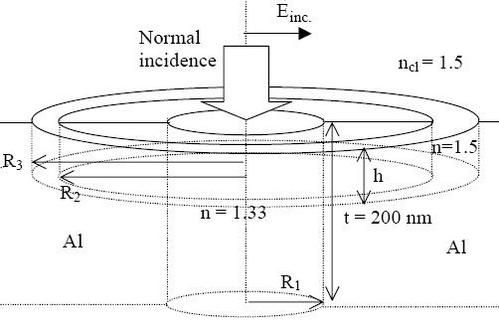
Latest paper published
Now it’s made available online : D. Gerard et al, Phys Rev B 77, 045413 (2008)
Briefly, we experimentally compare the properties of circular nanoapertures milled in gold and aluminium to enhance the fluorescence of dyes diffusing within the nanoapertures. Our main result is that nanoapertures in gold exhibit much higher fluorescence enhancement. We discuss the influence of a noble metal holding plasmonic resonances in the visible range such as gold. Altogether, these results provide crucial knowledge for the design of nanoapertures towards high-efficiency single-molecule analysis.

Demonstration microscope and Fourier optics
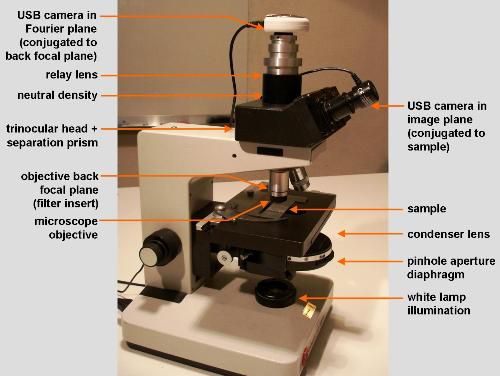
As an interdisciplinary project for students of the Ecole Centrale Marseille, a joint team with my lab developed a demonstration version of a trinocular microscope. The aim is to introduce students to the principles of image formation, Fourier optics, and basic contrast filtering techniques in microscopy. This work follows a pioneering demonstration by Peter Evenett (Leeds, UK).
Two USB video cameras are used: the first one observes the image of the sample, the second is conjugated to the microscope objective’s back focal plane (Fourier plane). This allows a simultaneous monitoring of both direct and Fourier images.
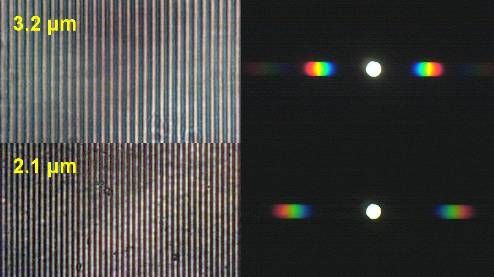
As an example, the following picture shows the direct (left) and Fourier (right) images of gratings with two different pitches. Smaller pitches yield farer diffracted orders in Fourier space.
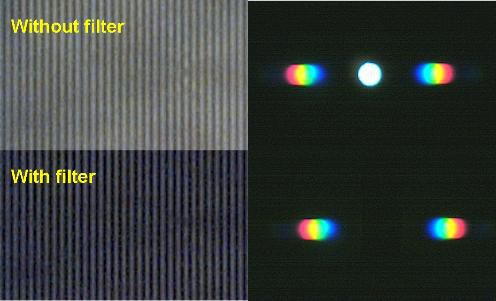
Different kind of filters can be set into the Fourier plane, direct observation on their influence on image formation can be inferred. In the following, a black mask is set in the back focal plane to suppress the central (non-diffracted) order. Only the first (plus and minus) diffracted orders are transmitted and contribute to the final image, giving a crisper contrast.
First book on diffraction
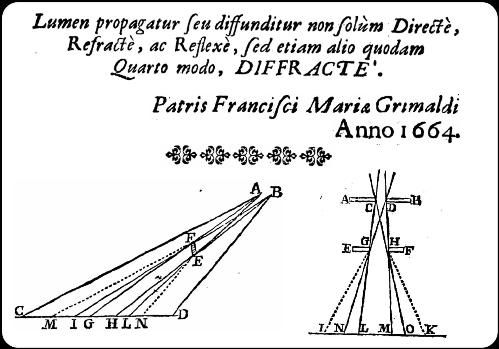
World’s first published studies on optical diffraction dating back to 1664, where the word “diffraction” itself was introduced for the first time. The original text is downloadable for free at the French National Library website http://gallica.bnf.fr/

/image%2F1383851%2F20250422%2Fob_a7cec0_logomosaic.png)
/image%2F1383851%2F20250422%2Fob_3502a9_logocnrs.jpg)
