Optical antennas special journal issue
The international journal of optics features a special issue focusing on optical antennas. Read the call for papers here. According to the lead guest editor, already twelve articles are scheduled from major research groups. Deadline for papers 1st september.

Summer School on Plasmonics Porquerolles SSOP 2
The deadline is approaching: before May 30th. Don't miss this opportunity!
Key arguments for your supervisor: excellent quality of invited lecturers + excellent value for the money, the registration fees cover all accomodation & food living expenses.
Make sure to check the SSOP2 official website.


Latest article : fluorescence directional sorting with antennas
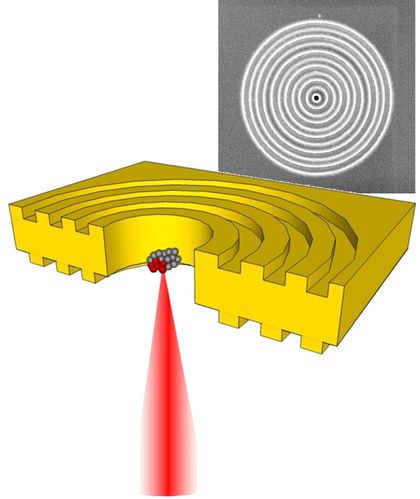
Despite intense recent research on optical antennas, tuning the directionality of fluorescence emission remains an open challenge for emitters with random positions and orientations. We address this issue in a recent Nano Letters report, and propose a class of optical antennas to control the fluorescence emission directivity for molecules in solution.
Following on our previous article “Bright Unidirectional Fluorescence Emission of Molecules in a Nanoaperture with Plasmonic Corrugations” by H. Aouani et al (Nano Lett. 2011, 11, 637–644), new scientific findings are now described and analyzed:
1) We describe new design paths for plasmonic antennas to tune the emission directivity based on physical optics interference concepts. This manuscript provides the first complete characterization of the interference phenomenon leading to fluorescence beaming, both experimentally and theoretically.
2) The key result is that for each emission wavelength the fluorescence beam can be directed along a specific direction with a given angular width. For the first time, we demonstrate directional photon sorting between emission beams of spectrally different molecules.

Top Gun Day is May 13th !!
Forget about administrative work, prepare yourself for the next Top Gun Day coming up next Friday. What is Top Gun Day ? Check the original TGD website.
Top Gun quotes to insert in your next (scientific) conference talk :
- "The further on the edge, the hotter the intensity"
- "I was inverted"
- "If you think, you're dead"
- "Reviewer, snnfffffff.... ....you stink"
Enjoy !

Research highlighted by CNRS Le Journal
Our recent research results on single molecule fluorescence control with nanoantennas have just been highlighted in the April issue of CNRS Le Journal, the monthly magazine presenting the most recent scientific results obtained within the CNRS. See the article on our research on page 13 : "Very Bright Molecules".

/image%2F1383851%2F20250422%2Fob_a7cec0_logomosaic.png)
/image%2F1383851%2F20250422%2Fob_3502a9_logocnrs.jpg)
