Assistant Professor position open on nanophotonics
The Fresnel Institute is hiring a top qualified researcher to fill an assistant professor (Maitre de Conference in French) position. The research topic will primarily deal with theoretical simulations of nanophotonics. Read the full details here, and the official announcement here. Deadline for applications March 25th.

Research highlighted by CNRS
Our latest research published in a Nano Letters article has been selected by the CNRS in the "highlighted news" section. Here is an English version:
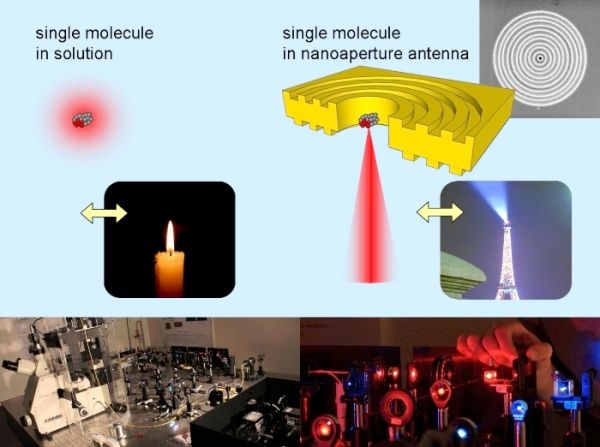
Molecular Nano-Headlight: turning a single molecule into a bright source of light
Looking for single molecules under the microscope. Many physical and chemical methods aim at analyzing single molecule behaviors. However, single molecule detection is a challenging task, due to the very weak amount of light that is radiated by a single molecule.
Nano-Antennas to control the emission of light. To increase and control the light emitted by a single molecule, scientists from the Fresnel Institute and the Institute of Supramolecular Science and Engineering ISIS use metal antennas of nanometer dimensions. These antennas are designed to work for light as conventional antennas work for radio waves. Both the emission intensity and direction can be controled down at the single molecule level, which realizes a major breakthrough.
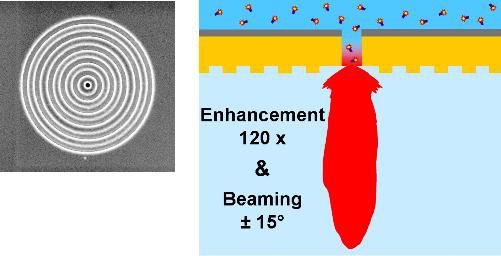
The researchers use a special kind of nanoantenna made of an aperture surrounded by circular corrugations milled in a gold film. This antenna transforms a standard molecule into a bright unidirectional fluorescence source: the fluorescence intensity is enhanced up to 120 fold, and almost all the light is emitted into a narrow cone in the vertical direction.
The bright emission and narrow directionality enable the detection of single molecules with a simple microscope, and improve the effectiveness of fluorescence-based applications. This demonstration is of high relevance for the development of biochemical sensing methods, light emitting devices, and quantum information processing.
NanoBioPhotonics Conferences selection 2011
Here is a quick list of conferences where my group's work will be presented. It also provides a short selection of European conferences on nano-bio-photonics, check the weblinks:
- March 14th: invited seminar at FOM-AMOLF, Amsterdam
- March 17th: "Antennas and near-field electromagnetics" workshop of the GdR Ondes, Paris
- May 16th-20th: invited course at the "Nano-objects and interfaces" NOIS 2011 topical CNRS school, Anglet
- May 19th-21st: "Molecular Plasmonics" conference, Jena
- May 23rd-26th: CLEO-EQEC Europe conference, Munich
- July 04th-07th: invited talk at "Coloq'12 Lasers and quantum optics colloqium", Marseille
- September 07th-09th: "Single molecule spectroscopy workshop", Berlin
- October 03rd-07th: invited talk at "Summer School on Plasmonics II SSOP2", Porquerolles

Nano Letters paper published online
Our study on fluorescence enhancement and beaming in nanoapertures with circular corrugations has just been released on the Nano Letters website. See the abstract here. A free reprint (for personal use only) can be downloaded here.
Rationale: A wide range of applications in physical and chemical sciences is presently limited by the weak optical signal emitted by a single fluorescent molecule. To overcome this challenge, plasmonic antennas are receiving a growing interest to control both the fluorescence rate and angular emission distribution from single quantum emitters. However, there is currently no experimental demonstration reporting a clear improvement in both the emission intensity and directionality using the same nanoantenna. We solve this issue here.
Results: we report the demonstration of bright unidirectional photon sources from single molecules. The emission rate per molecule is enhanced up to 120 fold, and simultaneously the fluorescence emission is directed into a narrow angular cone of 15°. This work has four major aspects of general interest:
1) Each of our results on enhancing the fluorescence signal and narrowing the angular distribution is going well beyond the current state-of-the-art, and moreover, we achieve both features simultaneously on the same structure, which is unique to our knowledge.
2) Nanoapertures surrounded by periodic corrugations have generated a considerable interest in the photonics community. This is the first study where corrugated apertures are used to enhance the detection of single molecules.
3) We thoroughly quantify the increased light-matter coupling and the radiation pattern at the single emitter level.
4) The bright emission and narrow directionality release the need for high-end microscope objectives. Efficient detection of single molecules is achieved with a simple low numerical aperture objective.
Scientific achievements 2007-2010
On January 05-06th, the entire Fresnel Institute will be evaluated regarding its activities during the 2007-2010 period. The final slide of my presentation for this evaluation will summarize the main achievements (see the links to read more):
2007: live cell membrane investigations with nanoapertures
2008: complete fluorescence characterization in nanoapertures & microsphere-enhanced fluorescence
2009: 100x speed increase in FCS measurements & crucial role of the gold adhesion layer in plasmonics
2010: smallest single molecule fluorescence endoscope & quantum dots to probe nanoantennas
As I will go through several evaluation processes in 2011 (for fundings, CNRS progress...), I hope this type of slide may also help.


/image%2F1383851%2F20250422%2Fob_a7cec0_logomosaic.png)
/image%2F1383851%2F20250422%2Fob_3502a9_logocnrs.jpg)
